DG DGMind
Foundations
Module 4 of 6 · Foundations

The nine classes — in everyday words

Class 1 explosives to Class 9 misc. — one familiar example each, plus the real placard.

ADR 2025 · 2.1 / 2.2
Friendly introduction & study aid. Not the official ADR certificate. The legal certificate comes from a DfT/SQA-approved training centre and the SQA exam.
Draft beginner content — pending review by a qualified DGSA
Loading module video…

Lessons

Indigo · Lesson

Classes 1, 2, 3 — bangs, gases, flames
1 min 1 · Explosive 2 · Gas 3 · Flammable liquid ADR 2025 · 2.2.1 / 2.2.2 / 2.2.3
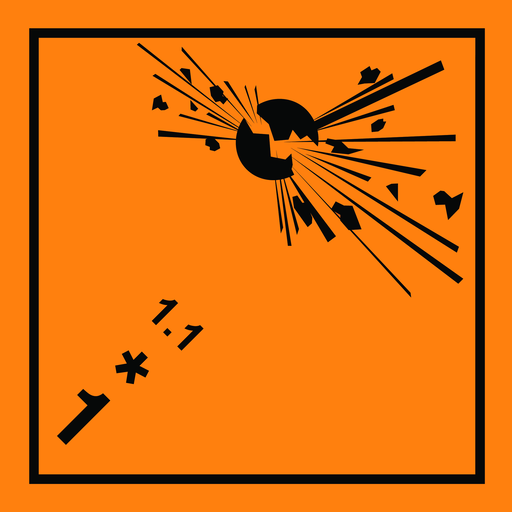
ADR hazard class 1 — Explosive1 · Explosive
ADR hazard class 2 — Gas2 · Gas
ADR hazard class 3 — Flammable3 · Flammable liquid
New to this? You don't need any background in chemistry or transport law to start here — just a willingness to think about why certain loads need special care on the road. After this lesson you'll be able to name Classes 1, 2 and 3, describe the everyday goods that fall into each, and explain in plain words why each one is dangerous.

ADR — the international agreement that governs dangerous goods by road in the UK and across Europe — divides every hazardous substance into one of nine numbered classes.This lesson covers the first three, which together deal with the most dramatically energetic hazards you'll encounter.Class 1 is explosives.An explosive is a substance or article that can very rapidly release energy as a blast, shock, or heat — think fireworks at a display, the ammunition in a police or military convoy, or the small blasting caps used in construction.The danger is obvious: a single ignition source at the wrong moment can trigger a chain reaction.Because of this, Class 1 goods have some of the strictest carriage rules in ADR.Class 2 is gases.Gases are dangerous partly because they are pressurised — a punctured cylinder can become a projectile — and partly because many gases are also flammable, toxic, or both.The LPG canister on a barbeque is Class 2, as is the propane powering a forklift truck, and the oxygen cylinder used in a hospital.The pressurised state is key: damage to the container changes the risk immediately.Class 3 is flammable liquids.These are liquids that give off enough vapour at relatively low temperatures to ignite from a spark or a flame.Petrol, with UN number 1203, is the everyday example almost every driver in the UK will recognise.White spirit, paint thinners, and methylated spirits all belong here too.The key risk is the invisible vapour — it travels along the ground and can reach an ignition source metres away from the spill itself.All three classes have their own diamond-shaped hazard label, and a vehicle carrying above the ADR threshold must display orange-plate markings and placards so emergency services can identify the load at a glance.

Class 1 = explosives (fireworks, ammunition).
Think of it like this: Think of Classes 1, 2 and 3 as a fireworks night in your back garden: Class 1 is the rocket itself (it explodes), Class 2 is the pressurised gas canister on the patio heater (it can blast or burn), and Class 3 is the bottle of lighter fluid sitting on the table (it catches fire from the tiniest spark).
Worked example

A small courier is asked to take six jerry cans of petrol (UN1203) from a fuel depot to a film-set generator. A colleague asks: 'Which ADR class is that, and why?'

  1. 1Step 1 — Identify the substance: petrol is a liquid derived from crude oil. Is it flammable? Yes — it ignites easily from a spark at normal UK ambient temperatures.
  2. 2Step 2 — Match to the class definitions: Class 3 covers flammable liquids. Petrol fits squarely here. Its UN number, 1203, confirms this.
  3. 3Step 3 — Note the hazard: petrol vapour is heavier than air and spreads at ground level; an ignition source metres away from a spill can set it alight.
  4. 4Step 4 — Label and placard check: each jerry can must carry a Class 3 diamond label (red flame), and the vehicle must display a Class 3 placard if the load exceeds ADR thresholds.

Petrol (UN1203) is a Class 3 flammable liquid. The colleague should expect a red diamond flame label on each container and, if the quantity triggers ADR requirements, orange-plate markings and a Class 3 placard on the vehicle.

Key points
  • Class 2 = gases (BBQ propane, oxygen cylinder).
  • Class 3 = flammable liquids (petrol, paint thinner).
Words explained — tap any term
ADR Citation
ADR 2025 · 2.2.1 / 2.2.2 / 2.2.3
ADR Part 2 defines class 1 (explosives), class 2 (gases) and class 3 (flammable liquids); each class has its own diamond label and classification criteria.
Draft content, pending DGSA review. Verify against the cited clause before relying on it.
Indigo · Lesson

Classes 4 and 5 — solids that burn, things that make others burn

1 min 4.1 · Flammable solid 4.2 · Spontaneous 4.3 · Wet = danger ADR 2025 · 2.2.41 / 2.2.42 / 2.2.43 / 2.2.51 / 2.2.52
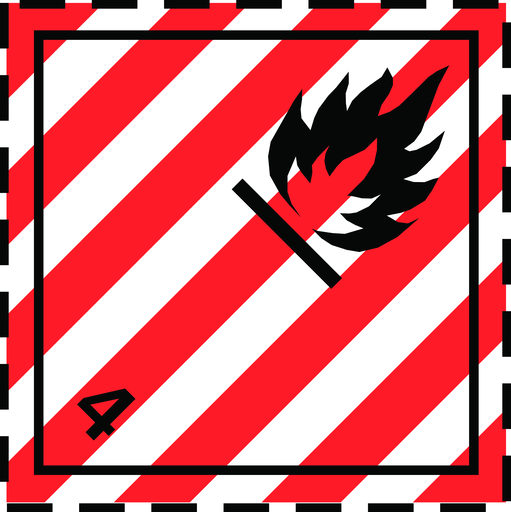
ADR hazard subclass 4.1 — Flam. solid4.1 · Flammable solid
ADR hazard subclass 4.2 — Flam. solid4.2 · Spontaneous
ADR hazard subclass 4.3 — Flam. solid4.3 · Wet = danger
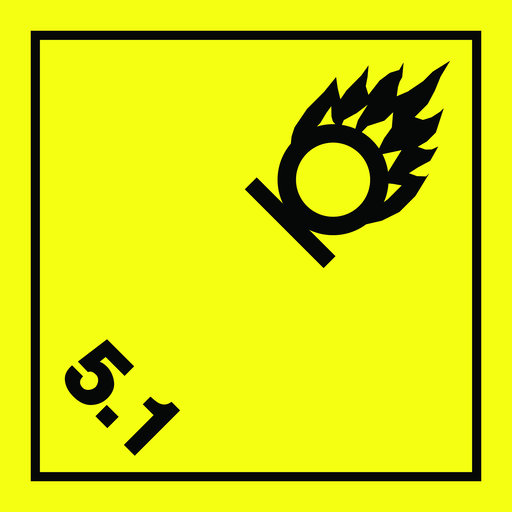
ADR hazard subclass 5.1 — Oxidiser5.1 · Oxidiser
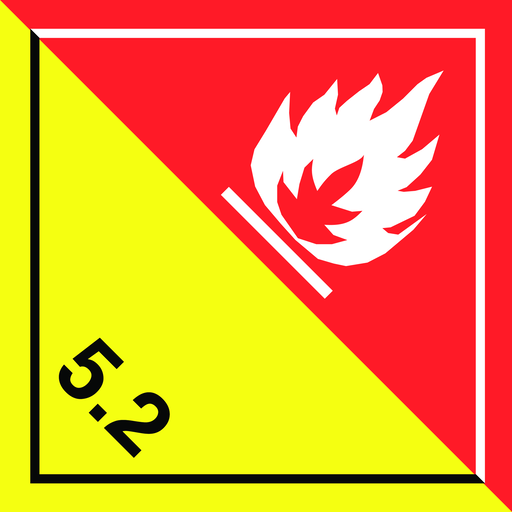
ADR hazard subclass 5.2 — Oxidiser5.2 · Organic peroxide
New to this? You don't need any chemistry knowledge here — if you can picture a box of safety matches or a tub of swimming-pool chlorine tablets, you already have the right mental image. After this lesson you'll be able to distinguish the three sub-classes of Class 4 and explain why Class 5 oxidisers are dangerous even though they don't burn themselves.

Classes 4 and 5 cover hazards that are a step less obvious than a can of petrol or a gas cylinder, which is exactly why it pays to understand them clearly.Class 4 is split into three sub-classes, each describing a different route by which a solid substance becomes a fire hazard.Class 4.1 — flammable solids — are materials that can catch fire from a brief contact with a flame or spark and keep burning.Matches are the textbook example; so are some metal powders.Class 4.2 — spontaneously combustible — are materials that can ignite all by themselves if exposed to air or moisture, without any external flame.Oily rags soaked in linseed oil are the classic workshop hazard: piled together, they generate enough heat to self-ignite.This is also where pyrophoric substances sit.Class 4.3 — water-reactive — are materials that emit flammable gases when they get wet.Sodium metal reacts violently with water; if you tried to extinguish a sodium fire with a hose, you would make it dramatically worse.The key takeaway is never to use water on a Class 4.3 incident.Class 5 moves from 'things that burn' to 'things that make burning worse'.An oxidiser does not itself catch fire, but it supplies the oxygen that a fire needs to become far more intense.Class 5.1 covers oxidising substances — swimming-pool chlorine tablets (calcium hypochlorite) are a common UK road-transport example.Class 5.2 covers organic peroxides, which appear in some adhesive hardeners and industrial processes.The practical danger: a spill of a Class 5.1 oxidiser into a Class 3 flammable liquid is not just twice as dangerous — the oxidiser can cause an ordinary fire to burn far hotter and faster than normal firefighting equipment is designed for.

Class 4 = flammable solids (matches, oily rags, water-reactive metals).
Think of it like this: Think of a bonfire: Class 4 materials are the wood and paper that burn (4.1), the pile of oily cloths that can catch fire with no match needed (4.2), and the magnesium strip that explodes if you pour water on it (4.3). Class 5 is the bag of fire-lighter fluid you throw on — it doesn't burn on its own, but everything else around it burns ferociously.
Worked example

A warehouse operative loads a pallet of calcium hypochlorite (swimming-pool chlorine tablets, Class 5.1) next to several drums of white spirit (Class 3) in a van. A DGSA trainee is asked to explain why this mixed load is a concern.

  1. 1Step 1 — Identify the classes: calcium hypochlorite is Class 5.1 (oxidising substance); white spirit is Class 3 (flammable liquid).
  2. 2Step 2 — Understand the interaction risk: the oxidiser (5.1) releases oxygen that dramatically intensifies any fire; the flammable liquid (3) provides the fuel. Together, a spill or leak creates conditions for a fire that burns far hotter than either substance alone.
  3. 3Step 3 — Recall the sub-class principle: Class 5.1 oxidisers are not themselves on fire, but they are incompatible with flammable substances — ADR contains segregation rules specifically to keep these classes apart.
  4. 4Step 4 — Advise the operative: these two classes should not be loaded together without checking ADR's mixed-loading (segregation) provisions. A DGSA should review the load plan before departure.

The mixed load is a concern because a Class 5.1 oxidiser will intensify any fire from the Class 3 flammable liquid. ADR's segregation rules exist precisely to prevent this combination — the load plan should be reviewed by a DGSA before the vehicle moves.

Key points
  • Class 5 = oxidisers (pool chlorine, peroxides).
  • Oxidisers don't burn themselves — they help others burn much harder.
Words explained — tap any term
ADR Citation
ADR 2025 · 2.2.41 / 2.2.42 / 2.2.43 / 2.2.51 / 2.2.52
Classes 4.1, 4.2, 4.3 cover flammable solids, spontaneously combustible substances and substances that emit flammable gases on contact with water; classes 5.1 and 5.2 cover oxidising substances and organic peroxides.
Draft content, pending DGSA review. Verify against the cited clause before relying on it.
Indigo · Lesson

Classes 6 and 7 — poisons and radioactivity

50s 6 · Toxic / infectious 7 · Radioactive ADR 2025 · 2.2.61 / 2.2.62 / 2.2.7
66 · Toxic / infectious
77 · Radioactive

Classes 6.1, 7 and 9 use illustrative placeholders until official artwork is supplied.

New to this? You don't need a science degree or any medical knowledge to follow this lesson — the ideas map directly onto things you've heard of in everyday news. After this lesson you'll be able to tell Class 6.1 (toxic) from Class 6.2 (infectious), describe what makes Class 7 radioactive material unusual, and explain why even small quantities of Class 7 goods carry strict rules.

Classes 6 and 7 both involve hazards you cannot always see, smell, or feel, which makes clear labelling and correct handling procedures especially important.Class 6 is divided into two very different sub-classes.Class 6.1 — toxic substances — are materials that can poison humans or animals through swallowing, skin contact, or breathing in fumes.Pesticides transported to farms are a common UK road-transport example.Industrial chemicals such as cyanide compounds also fall here.Class 6.2 — infectious substances — are materials that contain, or are reasonably expected to contain, pathogens (bacteria, viruses, or other micro-organisms) capable of causing disease in humans or animals.Clinical lab samples, blood specimens, and diagnostic cultures are typical examples.The packaging rules for 6.2 are particularly strict because a leak in transit could expose postal workers, couriers, or emergency services to harmful biological material.Class 7 — radioactive material — covers substances that spontaneously emit ionising radiation.Medical isotopes used in hospital scans and industrial gauges are the most common UK road-transport examples.What makes Class 7 unusual is that the radiation cannot be detected without specialist equipment, and the health effects of over-exposure can be delayed.Because of this, ADR imposes dedicated provisions for Class 7 — additional paperwork and strict quantity controls — that go beyond the rules for most other classes.

Class 6.1 = toxic (pesticides, cyanide).
Think of it like this: Think of Class 6.1 as a bottle of rat poison in your kitchen cupboard — small enough to carry, but a serious health risk if mishandled. Class 6.2 is like a sealed hospital blood sample in a courier bag — harmless if packaged correctly, but potentially spreading disease if the bag leaks. Class 7 is like a smoke detector: it emits something invisible that you cannot sense without a detector, and the rules around it are strict precisely because the hazard is not obvious.
Worked example

A medical courier is asked to transport two separate consignments: (A) a sealed box of clinical blood samples from a GP practice to a hospital laboratory, and (B) a box of agricultural pesticide concentrate to a farm. A trainee asks which ADR class each belongs to and what the key handling difference is.

  1. 1Step 1 — Classify consignment A: blood samples from a GP practice may contain pathogens. Substances that are reasonably expected to contain micro-organisms causing human disease are Class 6.2 (infectious substances).
  2. 2Step 2 — Classify consignment B: pesticide concentrate is designed to be toxic to living organisms and can harm humans through contact or inhalation. This is Class 6.1 (toxic substances).
  3. 3Step 3 — Identify the key handling difference: Class 6.2 has particularly strict packaging requirements to prevent any leak reaching the handler. Class 6.1 requires appropriate toxic-hazard labelling and correct packing group assignment based on the level of toxicity. A DGSA should confirm the specific packaging requirements for each consignment.
  4. 4Step 4 — Practical note for the driver: both consignments need Class 6 diamond labels on their packaging and must be accompanied by the correct transport documentation. A DGSA should confirm the specific packaging and paperwork requirements before the run.

The blood samples are Class 6.2 (infectious); the pesticide is Class 6.1 (toxic). The key difference is packaging — Class 6.2 has strict containment requirements to prevent any biological leak, while Class 6.1 focuses on toxicity-appropriate labelling and packing group classification. Your DGSA should confirm the exact requirements for each consignment.

Key points
  • Class 6.2 = infectious (lab samples).
  • Class 7 = radioactive (medical isotopes, gauges).
Words explained — tap any term
ADR Citation
ADR 2025 · 2.2.61 / 2.2.62 / 2.2.7
Class 6.1 covers toxic substances, class 6.2 infectious substances; class 7 covers radioactive material and is governed by additional dedicated provisions in chapter 2.2.7.
Draft content, pending DGSA review. Verify against the cited clause before relying on it.
Indigo · Lesson

Classes 8 and 9 — corrosives and 'everything else dangerous'

1 min 8 · Corrosive 9 · Miscellaneous ADR 2025 · 2.2.8 / 2.2.9
ADR hazard class 8 — Corrosive8 · Corrosive
99 · Miscellaneous

Classes 6.1, 7 and 9 use illustrative placeholders until official artwork is supplied.

New to this? You don't need any technical background here — if you've ever handled bleach carefully or worried about a lithium battery overheating in a laptop bag, you already have the right instinct for this lesson. After this lesson you'll be able to describe what makes Class 8 corrosives dangerous, explain why Class 9 exists as a catch-all category, and give a real-world example of a Class 9 good you'll encounter regularly in UK road transport.

Classes 8 and 9 round out the nine-class system and together cover two very different types of hazard.Class 8 is corrosives.A corrosive substance chemically attacks and destroys living tissue (especially skin and eyes) and can also degrade metals, plastics, and other materials on contact.In UK road transport you'll come across Class 8 goods regularly: concentrated bleach heading to a cleaning contractor, sulphuric acid (UN1830) in industrial batteries or manufacturing deliveries, strong drain-cleaning fluids, and car-battery acid.The hazard is contact — a leaking Class 8 package can burn a driver's hands or eat through the floor of a van.This is why Class 8 packaging rules require robust, chemically resistant containers and why the diamond label (showing a liquid dripping onto a hand and a surface) is one of the most instantly recognisable in the system.Class 9 is the miscellaneous class — it exists specifically for dangerous substances and articles that have a genuine road-transport hazard but do not fit neatly into Classes 1 through 8.The single most important Class 9 example in modern UK logistics is lithium batteries (UN3480 for lithium-ion cells or batteries; there are related UN numbers for batteries packed with or contained in equipment).Lithium batteries are not flammable like petrol, not corrosive like acid, not explosive like Class 1 — but if they are damaged, short-circuited, or incorrectly charged, they can short, overheat and catch fire in a way that is very difficult to extinguish.Because of the explosion in e-commerce and electric-vehicle logistics, lithium batteries now appear in large volumes on UK roads every day, making Class 9 far more practically significant than its 'miscellaneous' label might suggest.Class 9 also includes environmentally hazardous substances.

Class 8 = corrosive (bleach concentrate, sulphuric acid).
Think of it like this: Class 8 is like a cup of very strong vinegar scaled up to industrial strength — you know not to get it on your skin because it will burn, and you know it will eat through cheap packaging. Class 9 is the junk drawer in your kitchen: everything genuinely hazardous that doesn't fit the other labelled compartments goes in there, and lithium batteries are the most common item in that drawer.
Worked example

An e-commerce fulfilment depot is preparing a mixed pallet: several boxes of replacement laptop batteries (lithium-ion, UN3480) and two large containers of sulphuric acid solution (UN1830) for a battery-recycling firm. A new logistics supervisor asks the in-house DGSA trainee to classify both goods and flag any concern with the combined load.

  1. 1Step 1 — Classify the laptop batteries: lithium-ion batteries carry UN number 3480 and are Class 9 (miscellaneous dangerous goods). Their primary risk is overheating leading to self-sustaining fire — especially if damaged or short-circuited.
  2. 2Step 2 — Classify the sulphuric acid: sulphuric acid carries UN number 1830 and is Class 8 (corrosive substance). It attacks skin, eyes, and many materials on contact.
  3. 3Step 3 — Consider the combined load risk: a leaking Class 8 corrosive could damage the outer packaging of the Class 9 lithium batteries; physical damage to a lithium battery increases the risk of overheating significantly. Storing a corrosive in contact with battery packaging is therefore a double hazard.
  4. 4Step 4 — Advise the supervisor: both loads require their respective diamond labels (Class 8 corrosive placard; Class 9 miscellaneous placard). The DGSA should review whether ADR's mixed-loading provisions permit these two classes together and, if so, what physical separation is required.

The laptop batteries are Class 9 (UN3480); the sulphuric acid is Class 8 (UN1830). The concern is that a Class 8 leak could physically damage the Class 9 batteries and increase the risk of overheating and fire. The DGSA must confirm the mixed-loading rules and any required separation before the pallet is loaded.

Key points
  • Class 9 = miscellaneous — anything dangerous not in 1–8.
  • Lithium batteries (UN3480) are the headline Class 9 example.
Words explained — tap any term
ADR Citation
ADR 2025 · 2.2.8 / 2.2.9
Class 8 covers corrosive substances (which attack skin and other materials); class 9 covers miscellaneous dangerous substances and articles, including environmentally hazardous substances and lithium batteries.
Draft content, pending DGSA review. Verify against the cited clause before relying on it.

Practice questions

0 / 5 answered
  1. 1
    Petrol is which class?
  2. 2
    Which class is for corrosive substances like sulphuric acid?
  3. 3
    A propane gas bottle for a BBQ belongs to which class?
  4. 4
    Lithium-ion batteries (UN3480) belong to which class?
  5. 5
    Fireworks belong to which class?
Practice quiz — pick an answer to see whether it's right and why.